Showing posts with label bedding. Show all posts

Sunday, December 18, 2022

2022 Costuming/Historical Sewing Year in Review

It's that time of year when I take stock of my costuming accomplishments.  I've expanded this post to include other historical sewing since some of it required a boatload of research and took a lot of time.  Note that these projects are all sewn in the period manner.  If the period used machines, then a machine was used.  If hand sewing was the period standard, then the project was sewn by hand in the manner revealed in my research. Many of these items are accessories--some of which are just as labor intensive as full sized garments--particularly those with any embroidery or trim.  

One thing that always amuses me when I make these year in review posts is how different this list often is from the goals list I make at the beginning of the year.  Two of these projects were on my goals list.  At least two of those original goals that weren't completed will go on my goals for 2023 list.  LOL.  Sometimes my research and needs just takes me in a different direction!

This post does not include my modern sewing projects which includes three 1950's style frocks and 3 or 4 other garments.  I've listed these in order of completion and linked them to blog posts/tutorials where they exist.

1.  1921 black worsted tea frock.   This one was a lot more complicated than it appears to be!

      Detailed post with research can be found here. 


2. 1920s black taffeta petticoat.
    
Detailed post and tutorial can be found here.


3 and 4.  1786 Balloon hat and figured wool Italian gown.

               Detailed post and hat tutorial can be found here.


5, 6, and 7.   Three different silk bonnets.

                     Detailed post and tutorial can be found here:


8.  1780 Chintz gown.   Shown here with my friend Esther, who is wearing a gown of the same fabric!

      I'm on the right.  Detailed post can be found here.


9 and 10.  Two new work aprons.  The heavier white apron and the red checked apron are new.  

                 The blue one is included to show the new hand woven tape.  


11.  A new 1760s work gown for Widow Ferguson.   This gown is being worn with the white apron above         as well as a new linen voile handkerchief included with this project.
       Detailed post can be found here.


12.  1810s Regency cap made from a remnant of antique sprigged organdy.


13.  Linen bed gown.  It's hard to believe I haven't had a bed gown all these years.  I completed this one as         part of an 18th century home sewing presentation and found that I rather liked it.


14.  1920s brimmed cloche.  I wasn't sure whether to include this or not.  It was a fair amount of work.  It         was refashioned from a wide brimmed large brimmed thrift store hat that is 100% wool.  I had to         
       completely reblock it numerous times, cut away much of the brim and stiffen it more.  I should trim it 
       but haven't yet decided on what I want.


15.  Common linen mitts.    These were done as a sample for a mitts workshop.


16.  1770s Sheer organdy cap.  Another demo project for a workshop.


17.  1770s shift.  This one was a lot of work but desperately needed.


18.  In progress, fine linen voile Quaker cap.  Hopefully I'll finish it before the end of the year in which csse I will update.


Other history sewing that I don't wear:

Men's shirt.   This was made for a museum program on Esther deBerdt Reed.  I found myself demonstrating thread button making all day as the kids seemed to enjoy it.


Baby layette from Sharon Burnston's excellent instructions.


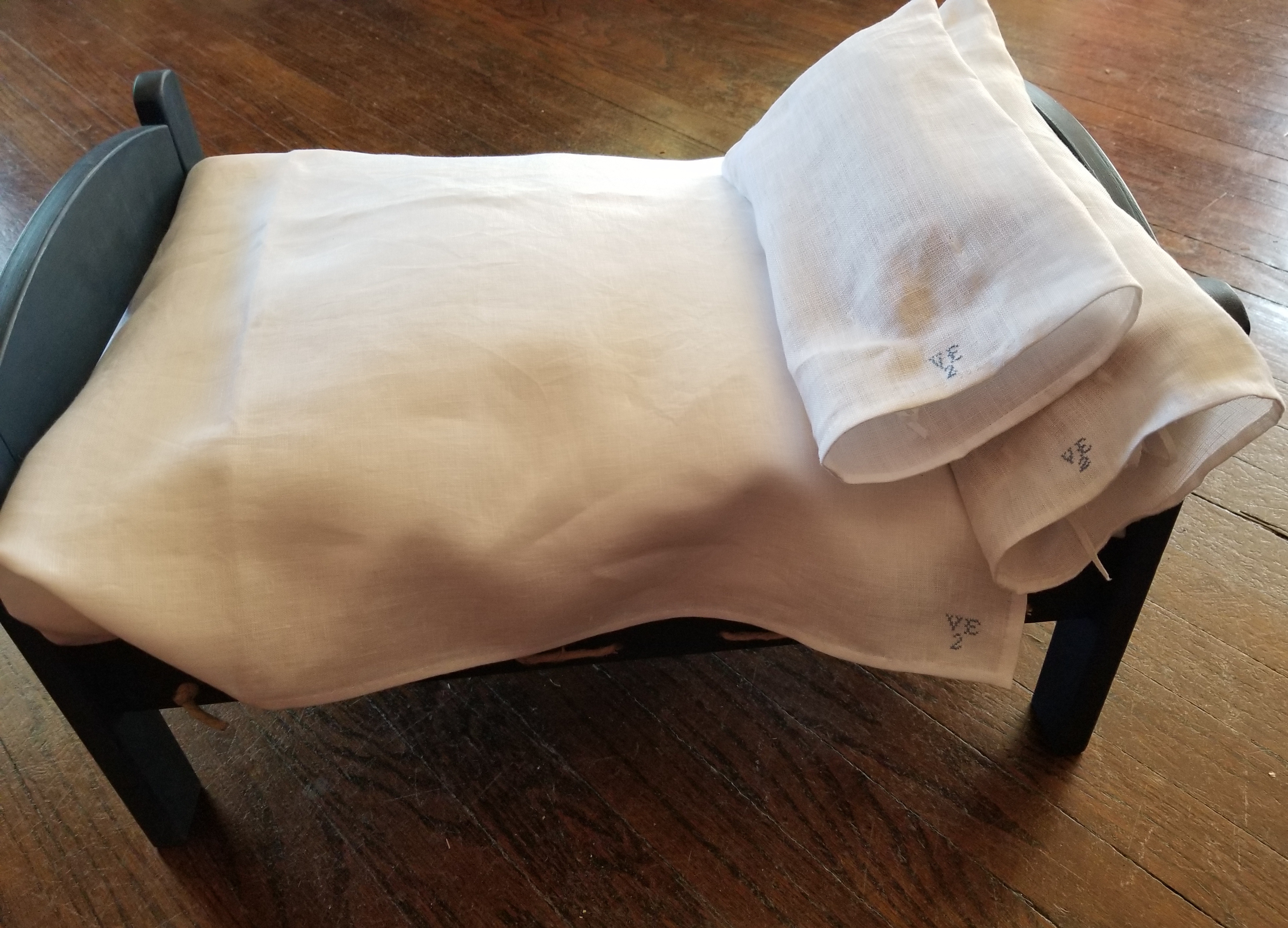
Miniature bedding project:  This was a lengthy project as I had to make the rope bed from an Ikea doll  
bed.  Details and research can be found here.


Rose blanket for the miniature bed:  research and details here.


In progress:  Blue checked men's shirt.  If I finish it, I'll update.

When I start these posts, I always think I didn't accomplish much--until I actually start counting and realize that I was rather productive!  I have a lot planned for 2023 and I suspect that what gets finished will not even be on that list if past years are an indicator. LOL.

Here's to a new year with lots of new sewing adventures!

Thursday, October 6, 2022

Adventures in Home Sewing --18th Century Edition Pt. 2: Rose Blanket

 This was an unexpected addition to my miniature bed project.  My friend Joan suggested that I "sharpen my embroidery skills and make a rose blanket."  I was intrigued by that comment because, quite honestly, I had never heard of a rose blanket. Naturally, I had to do a cursory Google search.  I found a number of pictures of extant rose blankets--wool blankets that had a wool embroidered circular motive resembling a compass rose in each corner.  The "roses" appeared to be stitched mostly with herringbone stitch in wool thread.  They also had blanket stitching on both ends along with a woven stripe parallel to the end.  Joan told me about one she bought at an antiques market for a very reasonable price.  She ended up donating it to a museum after learning that it was indeed an 18th century blanket.  Hers was in incredible shape.  It has some places that were darned but the embroidered corners were all completely intact.   Here are a couple of pics of Joan's blanket.


 Researcher John Rees has an article about blankets issued to the Continental Soldiers entitled: "To Colonel Morgan, for the use of the Light Infantry, twenty four Dutch Blankets & four pair of Rose Blankets." Examples of Bed Coverings Issued to Continental Troops that had a lot of wonderful information.  There are links within the article.  I enjoyed this article as it showed examples of different types of blankets.  I had never really studied them before, just purchasing one from a friend who had some 3 point (?) blankets woven to 18th century specs for use in living history.  There are helpful links in this article, including one to the blankets page on the 18th Century Material Culture website.

Wm. Booth, Draper also had a nice facebook post from a few years ago with pics of the rose designs along with some information.

I decided to see if these were commonly sold to the public so I did a search for rose blankets in the newspaper database from 1770 to 1780 for blankets.  This brought up legislative acts and merchant ads.  The legislative acts weren't specific as to the type of blankets but they simply referred to supplying the troops with blankets.  The ads were very specific.  One thing that surprised me was that all of the ads were from Pennsylvania and New York.  There was one from Boston and one from Baltimore.  Here are some examples of ads.  Some are complete because I find these types of ads interesting and informative.

Two ads from 1771, both from the New York Gazette:


New York Journal 1772

Two ads from the Pennsylvania Journal 1772

Boston 1773

Pennsylvania Packet 1773

Pennsylvania Packet 1775

New York Gazette 1777

Pennsylvania Evening Post 1778

Pennsylvania Ledger 1778

I hope you find these ads as interesting as I do.  I find that when looking for something specific, I tend to find a lot of other very specific items that I wasn't even thinking of!  This is how I get lost in that rabbit hole for hours. LOL

Here are some detailed images from a late 17th century rose blanket.  The lighter embroidery gets lost a bit in the image but you can see it if you look carefully!


An image from the late 18th century: The Death of Voltaire.  Note the rose blanket on the bed!

Making the miniature rose blanket:

Materials:
blanket material
wool thread/floss

It appears that all of these blankets were white or cream.  I happen to have a piece of the 3/4 yard remnant of white wool flannel that I recently purchased.  I measured the bed and determined that 22 X 27 inches seemed to be the optimum size for my little bed.

I had a bag of Paternayan wool crewel thread.  It seems to be a bit "fluffy" for this and larger than it should be at this scale but I decided to use it.  I also had another brand of wool floss that was thinner but I didn't have the colors I needed for this project.  That particular thread was purchased for a specific project anyway.  You can see the differences between the two (Paternayan on the right):


I decided to stick with the most common colors I noticed in the extants:  dark red, blue, gold

The extants I've seen had a blue or brown stripe woven into the blanket at each end.  I couldn't really accomplish that so I decided to do a line of blue running stitch.  Blanket stitches were done at each end.

Here is the motif and the edge:

You'll note that you can see my pencil marks!  I've learned not to care so much about that.  Sometimes it's easy to impose 21st century standards on 18th century sewing but I've learned to let go of that.  After researching quilted petticoats and whitework and finding that there were extants with original pencil markings still there, I figured if it was good enough for them, it was good enough for me. LOL

Here is the blanket on the little bed:


And here it is draped over the bed as in Joan's picture!  I've come full circle from when I first saw a rose blanket!


I have to say--this was a really rewarding project.  As noted in the first bedding post, this type of "practical" sewing is not what I typically enjoy doing.  The research involved really is what drew me in. The rose blanket also had embroidery which I love doing.  I was able to make it completely from stash.

I think this pretty much buttons up the bedding project though I've had people suggest that I should make a quilted coverlet.  I've resigned myself not to do anything quilted until my quilted petticoat is completed so that may be a future project.

I have a few more "home sewing" items to share in a future post!