Showing posts with label mourning. Show all posts

Monday, March 31, 2025

Adieu to Mrs. Green--18th century mourning practices

It's always hard to say goodbye.  The time has come to bid Adieu to Anne Catherine Hoof Green of Annapolis.  Died March 23, 1775.  Mrs. Green has been one of our most beloved local women and you can find out more about her at the links below.  The local living historian who has portrayed Mrs. Green for about 15 years is retiring so it was only appropriate to send her off in the style that a woman of her stature deserves.

A walking tour of sites that were important to the Green family.  The tour started at State Circle across the street from the Maryland State House, which is the oldest continually operating state house in the country.

Old Post Office  in Historic Annapolis

From there, the tour progressed to the Jonas Green House which is under private ownership.  The family was so gracious in letting us use their home.  Two of Mrs. Green's sons were mourning in the first parlor where her obituary was read.  Then visitors progressed to the dining room where we had a few displays. I made a presentation about mourning dress and funeral traditions in the 18th century.  Some resources are listed below.

The Green House


From my presentation notes (Blogger isn't letting me cut and paste):


Newport Mercury 1-9-1775


Interesting article about a more simplefuneral procession: 

Newport Mercury 10-1-1764


Other ads about mourning materials being sold:

Maryland Gazette 6-14-1764

Providence Gazette 6-6-1764


New York Mercury 5-18-1767

This one is a particular  favorite in that it advertises hair plaiting for mourning jewelry.  We typically see plaited hair jewelry in the early 19th century though there is a piece that belonged to the Handcock family from the 1790s in the Massachusetts Historical Society.


Extant baker's wrapper dated 1828

I ended up making funeral biscuits for the participants to snack on:

Other photos from the house:
Parlor with casket

Local minister and Mrs. Green's sons

Some items printed by Jonas and Ann

Mourning gloves and mitts

                                                                      Mourning Jewelry

Me with my display

From the house, we proceeded to St. Annes where we learned about burial traditions, who prepared the body and how it was prepared.  The Greens are buried at St. Anne's in unmarked graves.
St. Annes


Our last stop was The Reynolds Tavern across the street.  The tavern was founded in 1747.  We had a toast to Mrs. Green.  The tavern prepares a punch based on the familiar 18th century recipes.

Punch at the Reynolds Tavern

I had so much fun doing this event.  I've always been fascinated by funeral/mourning customs so this really enabled me to delve into the subject and to show off some of my collection of mourning accessories.  It was also a nice way to say goodbye to Diane in her portrayal of Mrs. Green.

I would encourage you to read the first article in my resource list that profiles her life.


Memento Mori by William Michael Harnett

Resources:

Books

In Death Lamented:  The History of Anglo-American Mourning Jewelry

Mourning Dress:  A Costume and Social History

Articles

Ann Catherine Hoof Green--Maryland Archives

The Handsome Tokens of a Funeral:  Glove-Giving and the Large Funeral in Eighteenth-Century New England

"Often concerned in funerals:" Ritual, Material Culture, and the Large Funeral in the Age of Samuel Sewall--Colonial Society of Massachusetts

The Era of Excessive Mourning

The Colour of Mourning--All Things Georgian

Momentos Mori:  The Materials of Mourning--Colonial America 1607 - 1763

Colonial New England Funerals

The Lowest Ebb of Misery: Death and Mourning in the Family of George Washington

English Funeral Food

Recipe for Funeral Biscuits

Virginia Gazette March 1, 1737

Other primary accounts from Maryland State Archives


Tuesday, November 12, 2019

Mrs. Coffin's fancy half Handkerchief ca. 1770

One of my favorite portraits is that of Mrs. William Coffin (Anne Holmes) by John Singleton Copley painted ca. 1770.  I stumbled upon Mrs. Coffin while researching 18th century mourning gowns.  Mrs. Coffin appears to be wearing a simple black silk sacque back gown but it is her accessories that I found particularly enchanting.  Note the wired cap with tiny pleats that appears to tie under the chin.  There is what looks like an organdy bow with a satin or taffeta bow layered on top of it.  The choker is stunning--a row of what look like freshwater pearls at the top and bottom with large flat pearls in the center.  I'm unable to tell if the pearls are stitched down to a backing but the neck lookes darker behind them than it does in the "V" above her neck handkerchief. 


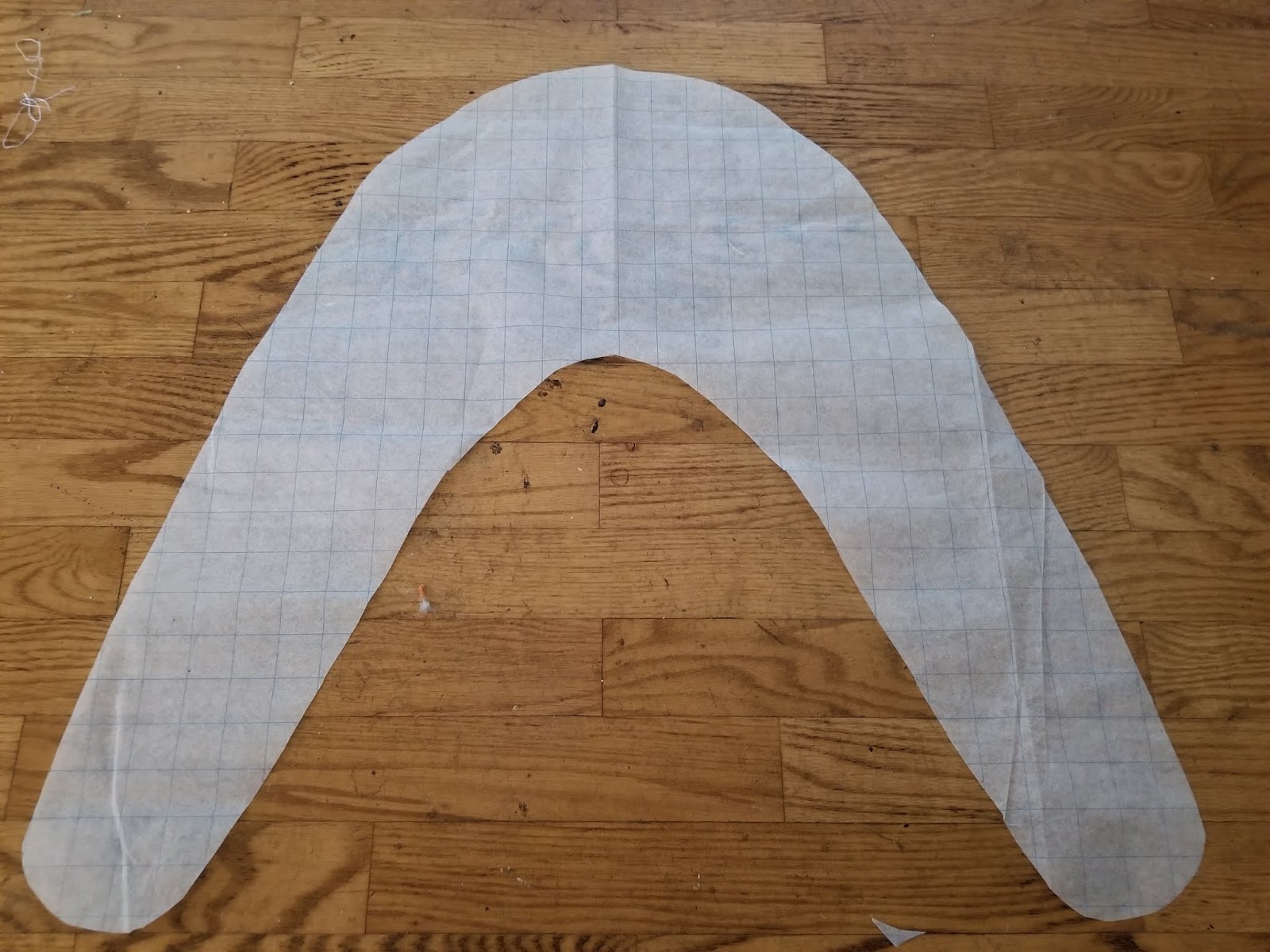
Speaking of the neck handkerchief, that is my favorite accessory.  I decided to copy it.  The sheerness of the textile leads me to believe that it may be silk gauze.   Other details:   Box pleated trim is applied to all the edges however the trim on the neck edge is narrower than the trim on the outer edge.  Also--I couldn't tell if it had wide box pleats set closely spaced or narrow box pleats set far apart.  I zoomed into the high definition image and determined that the trim was made with narrow box pleats spaced far apart.

I cut a shape I thought would work and tried it on. The angle of the "legs" was wrong as the shape did not lay flat on my shoulders. 

I took a huge tuck in the back to play with the angle and got the fit to work.

I traced the adjusted pattern, lengthening the legs.

I cut this shape out of silk gauze (organza) and made a tiny hem (less than 1/8 inch) hem around the edges.  The next task was to determine the width of the ruffles.   I played around with my measuring tape and determined that 1 1/2 inches on the neck edge and about 2 1/4 inches on the outer edge.  I cut strips across my 56 inch wide organza in these widths adding a bit for hem allowance, then I narrow hemmed the long edges. Since I wasn't sure how long to cut the strips, I started at the center back of the neck and just pinned the pleats in place.  I did the same with the outer edge, pinning the wider strip in place.  I ended up having to cut more so I cut a strip at the narrow width angling the edges until it was the wider width if that makes sense.  I used running stitch and spaced back stitch to stitch the strips to the hemmed edge of the handkerchief.  

Here it is for a final fitting.  I just used one pin to secure it then pinned the bow in place.

Here is the finished handkerchief worn over two different gowns.


I was very happy with this little project.  I love playing with accessories as I find that they can completely change the appearance of a gown.  Now I just need to get to work to finish the rest of Mrs. Coffin's mourning ensemble!

Thursday, May 16, 2019

Dressing Mrs. Ferguson: 1765-1770 Mourning gown

Elizabeth Ferguson, staymaker from London Town, Maryland, was widowed in 1770.  I've made a couple of gowns for Elizabeth--one being a chintz day gown and one being a wool/silk stuff winter gown.  I felt that it would be appropriate to create a mourning gown for her.  My research indicates that most mourning gowns of that era were made out of bombazine (silk and wool), silk or worsted.  The Fergusons were upper middle class working people--Scottish immigrants.  Elizabeth took on her husband's stay making business upon his death and she ran the ordinary that they owned. You can see Elizabeth's other gown here.  I decided that a fine wool would be the best choice for her as a practical working woman.  I was pleased to find black wool sateen with a corded stripe at Mood Fabrics.  The texture almost gives it the feel of dimity.


Here are the inspiration images I decided to work with.  The first two gowns are quite similar with a looser fitting cuffed sleeve.  The earlier gown has a strip in the front where a stomacher could be.  I was also intrigued by the white flounces on the sleeves in that one as I cannot tell if they are sewn to the gown or attached to the shift.  The ruffles on the second gown's sleeves are clearly attached to the shift.  The third image is inspiration for various accessories--in particular the handkerchief and cap which I may decide to make.

1752

1764

1772

I decided to use my favorite gown pattern with some modifications.  First I made the sleeve a little looser--only by about 1/2 inch.  I used the cuff pattern from Fitting and Proper which I had used on Mrs. F's other gowns but I made it larger so it would be more winged. I stitched a covered weight inside each cuff to make them hang properly. This gown can be worn with the plain stomacher or with a strip like in the first image for an earlier year.  

I also decided to make hip pads to wear in lieu of pocket hoops.


I like these pads--they're fairly modest in size but give the desired silhouette as seen below with the gown.  I also find them easier to wear than pocket hoops.


Once I had the hip pads, I could measure for the hem and make the petticoat.    

I had some leftover Swiss batiste which is lovely fabric.  I measured and cut some ruffles to tack inside the sleeves.


I basted the ruffles to the edge of the sleeve under the cuff.


This gown will be worn with a plain white voile handkerchief or with a finer tambour worked one depending on the occasion.  I will also wear a lappet cap --either my fine linen one or an organdy one that is a little fancier.  I feel like this gown could be dressed up with a 50's/60s wired winged cap which is also on my agenda.  I also made the deliberate choice to NOT wear an apron.  I looked at a lot of mourning portraits.  The vast majority of them showed no aprons.  One or two had black silk ones.  I don't know if this has to do with if the portraits were early in the mourning period or not.  I'll have to do more research.

For the photo shoot, I kept it basic with the linen cap and sheer muslin half handkerchief.

Photos were taken at the old Ellicott Family graveyard in Ellicott City, Maryland


I'm extremely pleased with this gown.  I love wool gowns. They're comfortable, they don't wrinkle and the colors are usually intense.  The looser sleeve is more comfortable and I like the winged cuffs.  I think the gown is perfect for Elizabeth Ferguson.